
Different Designs, Same Purpose: How Lizards Build Nature's Protective Materials
Researchers compare the structure of a lizards protective skin in six species and discover that nature uses surprisingly different material designs to achieve similar mechanical performance.

Nature has spent millions of years developing materials that are lightweight, durable, and resistant to damage. Bones, teeth, shells, and scales all achieve remarkable mechanical properties using relatively simple building blocks arranged in sophisticated ways.
A new study involving researchers Henrik Birkedal (Aarhus University) and Mads Ry Vogel Jørgensen (DanMAX, MAX IV) has taken a closer look at one of nature's lesser-known protective materials: the mineralized armor embedded in the skin of many lizards. By comparing six different species, the researchers found that nature has evolved multiple solutions for creating hard protective surfaces, revealing new insights into how microscopic structure influences material performance.
Key Findings
- Protective skin armor in all six lizard species contains a highly mineralized outer layer that is harder and stiffer than underlying bones
- Different structural designs can produce similar mechanical performance, demonstrating multiple evolutionary solutions to the same challenge
- Some species achieve exceptional stiffness using unusually large mineral crystals arranged almost randomly
- Other species use smaller but more highly aligned crystals to create protective tissues
- The findings may inspire future bio-inspired materials that combine hardness, stiffness, and damage resistance
Nature's Hidden Armor
Many lizards possess small bony plates embedded within their skin called osteoderms. These structures act as natural armor, helping protect the animals from predators and environmental challenges. On top of these osteoderms sits an even more specialized material known as capping tissue, a highly mineralized layer that can approach the stiffness of the hardest part of a tooth, the enamel.
Previous studies had shown that this capping tissue is often harder than bone, but little was known about how its structure varies between species. To investigate, the researchers compared osteoderms from six lizard species originating from different parts of the world as shown in Figure 1.
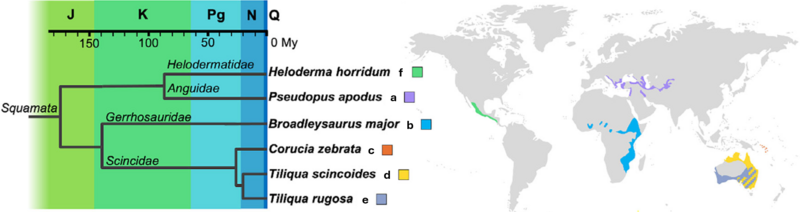
The team found that all species share the same basic principle: a highly mineralized outer layer sitting above ordinary bone. However, the detailed structure of that protective layer turned out to be surprisingly diverse.
Different Routes to Strong Material
All six lizard species build their protective capping tissue from the same mineral found in human bones and teeth, hydroxyapatite. Yet the mechanical properties varied considerably between species. One of the discoveries was that the protective tissues could be divided into two distinct structural groups.
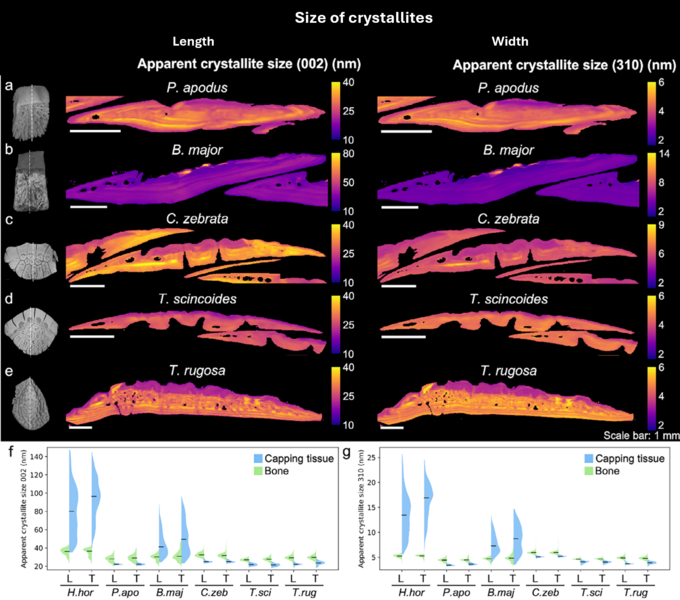
In two of the lizards the capping tissue contains unusually large mineral crystals (Figure 2 B). These crystals are among the largest observed in similar biological tissues and are arranged in an almost isotropic fashion, meaning they have little preferred orientation. Despite this seemingly disordered arrangement, the material exhibits exceptionally high stiffness.
The other four species followed a different strategy. Their capping tissues contained smaller crystals, but these crystals were more strongly aligned. Although their structure differed substantially, the resulting tissues still provided enhanced protection compared with ordinary bones (Figure 2 plots f and g).
How Did They Do It?
To understand the structure and performance of the lizard skin, the researchers combined several advanced characterization techniques:
- X-ray computed tomography (CT) to visualize the three-dimensional shape and mineral density of the material
- Nanoindentation mapping to measure stiffness and hardness across different regions of the tissues with micrometer-scale resolution
- Synchrotron X-ray diffraction to determine crystal size, crystal orientation, and atomic-scale structural differences
- X-ray fluorescence microscopy to map the distribution of trace elements such as strontium and zinc
- Finite element modelling to investigate how different tissue architectures influence stress distribution and mechanical performance
Looking Beyond Composition
This finding highlights an important lesson in materials science: there is often more than one route to achieving a desired property and the arrangement of matter can be just as important as the material itself. Nature does not rely on a single design principle but instead explores multiple structural solutions.
Why Does It Matter?
Materials scientists increasingly look to nature for inspiration when designing new materials. Biological systems often achieve combinations of properties that are difficult to reproduce using conventional engineering approaches.
This study shows that nature can reach similar mechanical goals through very different structural pathways. Understanding these relationships between structure and performance could help guide the design of future lightweight protective materials, coatings, and bioinspired composites. At the same time, the work advances our understanding of how evolution shapes biological materials across different species.
Want to know more?
You can learn more when exploring the full study in Advanced Functional Materials.
The work involved researchers from Aarhus University, MAX IV Laboratory, DTU and Danish Technological Institute. If you are interested in bio-inspired materials, advanced characterization techniques, or structure-property relationships in materials, explore the related research topics at AU Materials.