
What Can a Bachelor Project Lead To? More Complex Nanoparticles Without Surfactants
A student project at Aarhus University explores how a simple nanoparticle synthesis can be taken one step further. By combining gold and silver in different ways, the work shows how relatively simple chemistry can be used to build more complex nanomaterials.

Working together with her colleagues in the group of Jonathan Quinson at the Department of Biological and Chemical Engineering, Julie Agerbo Burslund investigated during her bachelor project how simple, surfactant-free synthesis methods can be used to produce nanoparticles containing both gold and silver. The work has now been published in Nano Letters.
The study builds on an idea already explored within the group: nanoparticles do not necessarily need complex mixtures of additives to remain stable. Surfactants are commonly added during nanoparticle synthesis to control particle growth and prevent the particles from sticking together. But they also cover the particle surface. That can be a disadvantage when researchers later want to use that surface for catalysis, sensing or further chemical modification.
The researchers investigated whether gold and silver could instead be combined using a simple room-temperature method based on water, alcohol and a base, without adding surfactants.
Mixing or Building a Shell
One important finding was that the way the two metals are added influences the type of particle that forms. Gold and silver can be mixed within the same nanoparticle to form an alloy. Alternatively, gold nanoparticles can first be formed and then covered with a layer of silver, creating a core-shell structure.
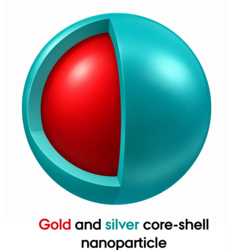
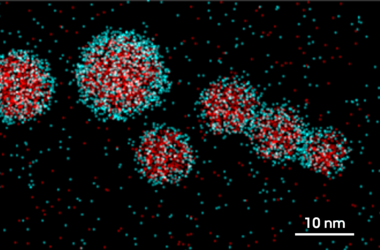
The researchers showed that the timing and sequence of adding gold and silver precursors can be used to steer the synthesis towards these different structures. The thickness of the silver shell can also be adjusted by changing the relative amount of silver. The resulting particles remained stable for several weeks, and the researchers showed that adding the silver surface also changes their catalytic behavior.
This is an important step beyond simply producing individual gold or silver nanoparticles. The existing gold particles can act as building blocks for more complex structures, while the process is more sustainable taking place at room temperature and without surfactants.
The work is also an example of how student projects can build on each other. Earlier projects in the group investigated simple surfactant-free syntheses of individual metal nanoparticles. Julie’s project took that work a step further by combining the two metals into more complex structures. Each project answers a new question and brings the research a little further.