
What Can a Student Project Lead To? When Empty Space Behaves Like an Atom
For Laura Berg her bachelor project became a research paper on an unusual idea: that empty space inside a material behaves like a "quasiatom".

During her bachelor at the Department of Chemistry, Aarhus University, Laura worked in the group of Maarten Goesten on computational studies of porous materials known as metal-organic frameworks, or MOFs. The work on quasiatomic pore states has now resulted in a publication in Newton.
Rather than carrying out experiments in the lab, Laura worked with calculations that can be used to explore how electrons behave inside a material. Together with Maarten, she performed the computational analysis behind the study.
The calculations revealed something unusual. We normally think of electrons as belonging to atoms or the chemical bonds between them. However, Laura and Maarten found electronic states concentrated right in the center of the pores, where the surrounding material holds the electrons in place.
When a Pore Behaves Like an Atom
What makes this particularly interesting is how these states are organized. Electrons around atoms can occupy different types of orbitals, which scientists commonly describe as s, p and d orbitals. The calculations reveal a similar pattern inside the pores. In this sense, the empty pore behaves as a kind of “quasiatom”, even though there is no atomic nucleus at its center.
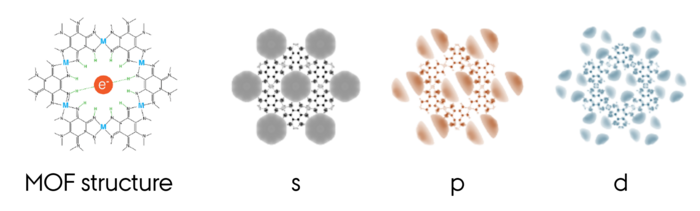
The calculations further show that these unusual pore states remain present even when the layers in the material are not perfectly aligned, an important consideration for real materials. As a result, the concept could be interesting for future studies of how the empty space inside porous materials could influence their electronic and chemical properties.
From Bachelor Project to Publication
For Laura, the project became an opportunity to contribute directly to fundamental materials research and follow the work all the way from calculations to a scientific publication as first author.
The study suggests a different way of thinking about porous materials: not only in terms of what their pores can contain, but also how the empty space itself can become part of the material’s properties.